
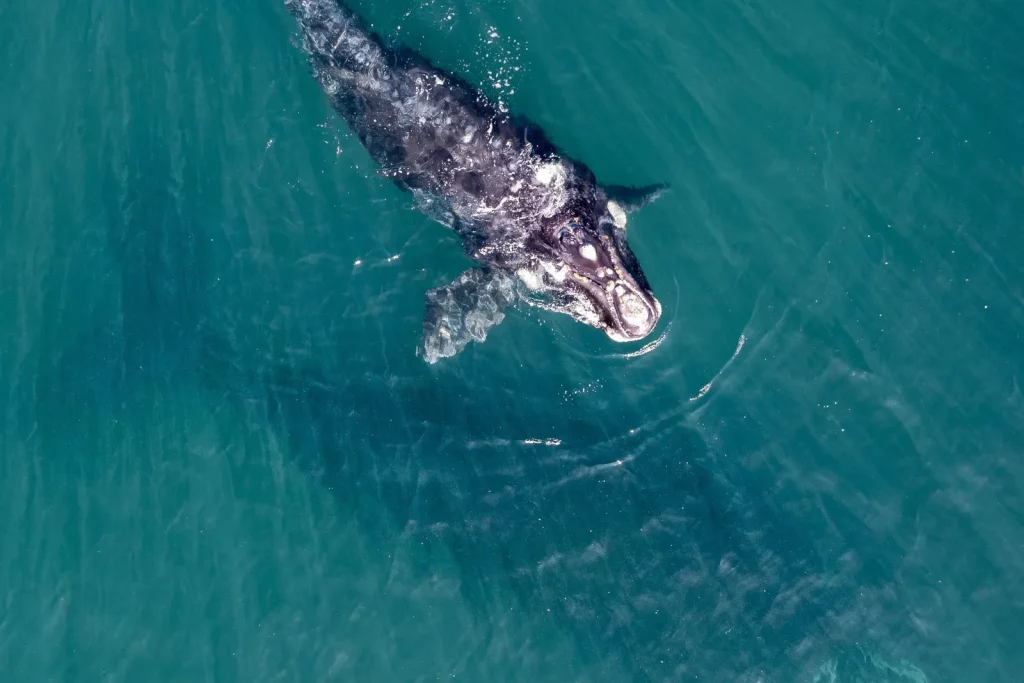
The grey whale makes one of the longest journeys of any mammal every year: it leaves the icy seas of the Arctic and travels down the whole Pacific coast to three quiet lagoons in Baja California Sur. There, between January and March, the females give birth and raise their calves in shallow, sheltered water. And there something happens that very few places in the world can offer: an animal fifteen metres long comes up to a small boat of its own accord and stays to look at the people inside.
What the grey whale is like
Its scientific name is Eschrichtius robustus. An adult measures between 13 and 15 metres and weighs around 30 tonnes, and females are slightly larger than males. Instead of a dorsal fin it has a small hump followed by a row of bumps running down towards the tail, like the knuckles of a hand.
Its skin is dark grey, mottled with white and dotted with barnacles and whale lice, small orange crustaceans. These marks form a pattern unique to each animal, and researchers use it to recognise individual whales in photographs year after year. When it breathes through its two blowholes, the spout opens into a heart shape.
A unique way of feeding
The grey whale feeds on the seabed. It rolls onto its side, sucks up the sediment and filters it through its short baleen to keep the small crustaceans and worms. It does this mainly in summer, in the cold waters of the Arctic. During the migration and the winter it barely eats: it lives off its stored fat and loses a good part of its weight.
A long life
It lives between 50 and 70 years and reaches sexual maturity between the ages of 6 and 12. Pregnancy lasts about a year, so a female conceives one winter and gives birth the next, back in the lagoons. The calf is born at around 4.5 to 5 metres long and weighs about half a tonne.
The great migration from the Arctic
The population that reaches Mexico spends the summer in the Bering and Chukchi Seas, between Alaska and Siberia. In autumn it heads south along the coasts of Alaska, Canada and the United States, and at the end of winter it makes the journey back. The full round trip covers between 16,000 and 20,000 kilometres.
The first to head north again are the males and the females without calves. Mothers with their young stay longer in the lagoons, until the calf is strong enough to swim thousands of kilometres.
A population watched closely
Commercial whaling in the 19th and 20th centuries brought it to the brink of extinction. With international protection it recovered to almost 27,000 whales around 2016. Between 2019 and 2023, the United States ocean agency recorded unusually high mortality along the coast, and the count for the winter of 2024-2025 fell to around 12,950, the lowest figure since the 1970s. The latest count, published in July 2026, estimates about 17,750, a rise the researchers themselves treat with caution. The figures are updated every year on the NOAA Fisheries page on grey whale abundance.
The lagoons where the calves are born: Ojo de Liebre, San Ignacio and Magdalena Bay
The grey whale breeds only in the lagoons on the Pacific coast of the Baja California peninsula. The water there is shallow, mild and very salty, sheltered from the swell of the open ocean, so the calf can breathe and feed calmly while it builds up fat for the journey. The first two lagoons belong to the El Vizcaíno Biosphere Reserve, and in 1993 UNESCO listed them as the Whale Sanctuary of El Vizcaíno, a World Heritage Site.
Ojo de Liebre Lagoon
The northernmost of the three lies next to Guerrero Negro, surrounded by dunes and the area’s vast salt flats. Ojo de Liebre usually gathers the largest number of whales and calves of the season. In English it is also known as Scammon’s Lagoon, after the whaling captain who sailed into it in the mid-19th century.
San Ignacio Lagoon
Further south lies the most remote of the three, with only simple camps and small fishing villages on its shores. San Ignacio is famous for its friendly whales. In February 1972, a grey whale came up to the panga of fisherman Francisco “Pachico” Mayoral and let itself be touched, the first encounter of its kind on record. Since then, every winter some mothers approach the boats with their calves, sometimes for long minutes.
Magdalena Bay
The southernmost lagoon is also the closest to La Paz. Bahía Magdalena is a system of channels, mangroves and dunes sheltered from the Pacific by the islands of Magdalena and Margarita. Boat trips leave mainly from Puerto Adolfo López Mateos and Puerto San Carlos.
On the Sea of Cortez side you will find other species, such as the blue whale and the humpback. The Pacific lagoons are the home ground of the grey whale.
When to see the grey whale: January to March
Every year the Mexican government publishes the dates when whale watching is allowed. According to the notice for the 2026-2027 season in Mexico’s Official Gazette (in Spanish), published on 22 October 2026, the season in Ojo de Liebre and San Ignacio runs from 15 December 2026 to 30 April 2027. In Magdalena Bay, with trips from Puerto San Carlos and Puerto Adolfo López Mateos, and in Puerto Chale, it runs from 1 January to 30 April 2027.
Within that period, the rhythm of the lagoons changes from week to week:
- December: the first whales arrive, mostly pregnant females.
- January: the first calves are born and the lagoons begin to fill up.
- February and March: the highest numbers of mothers with lively, curious calves, and the most rewarding time for close encounters.
- April: mostly mothers with calves remain, getting ready to leave for the north.
The official dates shift slightly from year to year, so check the current notice before you plan.
How to watch whales respectfully
In Mexico whale watching is regulated by the official standard NOM-131-SEMARNAT-2010, and only licensed boats may take part. In the lagoons you go out in pangas, the fibreglass boats of local fishermen, who know every channel and sandbank. The standard sets out clear rules:
- The boat approaches diagonally, from behind and parallel to the whale’s course, more slowly than the slowest animal in the group.
- Small boats watch from at least 60 metres away, and boats waiting their turn stay 240 metres away.
- A maximum of four boats may stay around the same whale or group, for up to 30 minutes.
- If the whale comes closer of its own accord, the engine goes into neutral and the whale decides how long to stay.
- Swimming or diving with the whales, feeding them and coming between a mother and her calf are all forbidden.
Your part
Choose licensed local operators, often cooperatives and families from the lagoon itself. In the panga, stay seated, speak softly and save sudden movements for dry land. The best encounters come when the boat stays still and everyone waits: the whales sense the calm, and that is when they come close.
Seeing the grey whale with Agarta
At Agarta Viajes we have prepared Baja California Sur · In the time of the whales, departing on 5 February 2027 from La Paz airport and returning on 16 February: twelve days right in the middle of the grey whale season. We travel in a group of no more than 14 people, José accompanies the whole journey and we work with local guides, among them a geologist and marine biologist. Our trips are guided in Spanish. On the second day we visit the Whale Museum in La Paz. The trip costs from €3,200 per person, and until 31 December 2026 the founding edition has a discount of €500 per person. If you wonder what it is about these animals that moves us so deeply, José tells it in his chronicle In the time of the whales · Why do they fascinate us so much?
Frequently asked questions
Can you touch a grey whale?
In the lagoons, especially San Ignacio, some whales come up to the pangas and stay beside them, and sometimes contact happens naturally. Mexican rules forbid chasing them or forcing contact, so the whale always takes the first step. Your guide will tell you what to do at every moment.
Which lagoon is best for seeing the grey whale?
All three are good and each has its own character. Ojo de Liebre usually has the most whales, San Ignacio is the most remote and the best known for close encounters, and Magdalena Bay is the easiest to reach from La Paz. Many travellers combine two of them.
How many grey whales are there in the eastern Pacific?
The latest NOAA Fisheries count, published in July 2026, estimates about 17,750 whales in the population that migrates between the Arctic and Mexico. The figure is reviewed every year.
How long does a whale-watching trip last?
Panga trips usually last around two hours, depending on the lagoon, the wind and the operator. The rules limit time with the same whale or group to 30 minutes, so you will see several animals during the outing.